Kamis, 16 November 2017

Cygnus Spacecraft seen from the International Space Station at Sunrise

Cygnus Spacecraft seen from the International Space Station at Sunrise

Orbital ATK's Cygnus resupply ship with its cymbal-ike UltraFlex solar arrays approaches the International Space Station's robotic arm Canadarm2 as both spacecraft fly into an orbital sunrise on November 14, 2017.

The cargo craft carried almost 7,400 pounds of crew supplies, science experiments, spacewalk gear, station hardware and computer parts. New research will explore the effectiveness of antibiotics on astronauts and observe how plants absorb nutrients in microgravity. Other experiments will deploy CubeSats to explore laser communications and hybrid solar panels.

Image Credit: NASA
Explanation from: https://www.nasa.gov/image-feature/sunrise-flight-to-the-space-station

U Antliae

U Antliae

Astronomers have used ALMA to capture a strikingly beautiful view of a delicate bubble of expelled material around the exotic red star U Antliae. These observations will help astronomers to better understand how stars evolve during the later stages of their life-cycles.

In the faint southern constellation of Antlia (The Air Pump) the careful observer with binoculars will spot a very red star, which varies slightly in brightness from week to week. This very unusual star is called U Antliae and new observations with the Atacama Large Millimeter/submillimeter Array (ALMA) are revealing a remarkably thin spherical shell around it.

U Antliae is a carbon star, an evolved, cool and luminous star of the asymptotic giant branch type. Around 2700 years ago, U Antliae went through a short period of rapid mass loss. During this period of only a few hundred years, the material making up the shell seen in the new ALMA data was ejected at high speed. Examination of this shell in further detail also shows some evidence of thin, wispy gas clouds known as filamentary substructures.

This spectacular view was only made possible by the unique ability to create sharp images at multiple wavelengths that is provided by the ALMA radio telescope, located on the Chajnantor Plateau in Chile’s Atacama Desert. ALMA can see much finer structure in the U Antliae shell than has previously been possible.

The new ALMA data are not just a single image; ALMA produces a three-dimensional dataset (a data cube) with each slice being observed at a slightly different wavelength. Because of the Doppler Effect, this means that different slices of the data cube show images of gas moving at different speeds towards or away from the observer. This shell is also remarkable as it is very symmetrically round and also remarkably thin. By displaying the different velocities we can cut this cosmic bubble into virtual slices just as we do in computer tomography of a human body.

Understanding the chemical composition of the shells and atmospheres of these stars, and how these shells form by mass loss, is important to properly understand how stars evolve in the early Universe and also how galaxies evolved. Shells such as the one around U Antliae show a rich variety of chemical compounds based on carbon and other elements. They also help to recycle matter, and contribute up to 70% of the dust between stars.

Image Credit: ALMA (ESO/NAOJ/NRAO)/F. Kerschbaum
Explanation from: https://www.eso.org/public/news/eso1730/

Exoplanet 55 Cancri e

Exoplanet 55 Cancri e
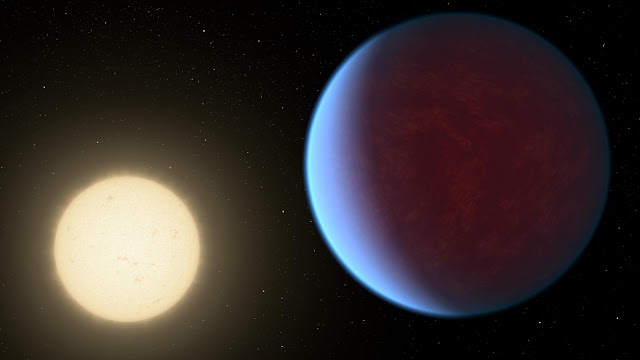
The super-Earth exoplanet 55 Cancri e, depicted with its star in this artist's concept, likely has an atmosphere thicker than Earth's but with ingredients that could be similar to those of Earth's atmosphere.

Twice as big as Earth, the super-Earth 55 Cancri e was thought to have lava flows on its surface. The planet is so close to its star, the same side of the planet always faces the star, such that the planet has permanent day and night sides. Based on a 2016 study using data from NASA's Spitzer Space Telescope, scientists speculated that lava would flow freely in lakes on the starlit side and become hardened on the face of perpetual darkness. The lava on the dayside would reflect radiation from the star, contributing to the overall observed temperature of the planet.

Now, a deeper analysis of the same Spitzer data finds this planet likely has an atmosphere whose ingredients could be similar to those of Earth's atmosphere, but thicker. Lava lakes directly exposed to space without an atmosphere would create local hot spots of high temperatures, so they are not the best explanation for the Spitzer observations, scientists said.

"If there is lava on this planet, it would need to cover the entire surface," said Renyu Hu, astronomer at NASA's Jet Propulsion Laboratory, Pasadena, California, and co-author of a study published in The Astronomical Journal. "But the lava would be hidden from our view by the thick atmosphere."

Using an improved model of how energy would flow throughout the planet and radiate back into space, researchers find that the night side of the planet is not as cool as previously thought. The "cold" side is still quite toasty by Earthly standards, with an average of 2,400 to 2,600 degrees Fahrenheit (1,300 to 1,400 Celsius), and the hot side averages 4,200 degrees Fahrenheit (2,300 Celsius). The difference between the hot and cold sides would need to be more extreme if there were no atmosphere.

"Scientists have been debating whether this planet has an atmosphere like Earth and Venus, or just a rocky core and no atmosphere, like Mercury. The case for an atmosphere is now stronger than ever," Hu said.

Researchers say the atmosphere of this mysterious planet could contain nitrogen, water and even oxygen -- molecules found in our atmosphere, too -- but with much higher temperatures throughout. The density of the planet is also similar to Earth, suggesting that it, too, is rocky. The intense heat from the host star would be far too great to support life, however, and could not maintain liquid water.

Hu developed a method of studying exoplanet atmospheres and surfaces, and had previously only applied it to sizzling, giant gaseous planets called hot Jupiters. Isabel Angelo, first author of the study and a senior at the University of California, Berkeley, worked on the study as part of her internship at JPL and adapted Hu's model to 55 Cancri e.

In a seminar, she heard about 55 Cancri e as a potentially carbon-rich planet, so high in temperature and pressure that its interior could contain a large amount of diamond.

"It's an exoplanet whose nature is pretty contested, which I thought was exciting," Angelo said.

Spitzer observed 55 Cancri e between June 15 and July 15, 2013, using a camera specially designed for viewing infrared light, which is invisible to human eyes. Infrared light is an indicator of heat energy. By comparing changes in brightness Spitzer observed to the energy flow models, researchers realized an atmosphere with volatile materials could best explain the temperatures.

There are many open questions about 55 Cancri e, especially: Why has the atmosphere not been stripped away from the planet, given the perilous radiation environment of the star?

"Understanding this planet will help us address larger questions about the evolution of rocky planets," Hu said.

Image Credit: NASA/JPL-Caltech
Explanation from: https://www.nasa.gov/feature/jpl/lava-or-not-exoplanet-55-cancri-e-likely-to-have-atmosphere

Rabu, 15 November 2017

Galaxy Cluster Abell 665

Galaxy Cluster Abell 665

The Universe contains some truly massive objects. Although we are still unsure how such gigantic things come to be, the current leading theory is known as hierarchical clustering, whereby small clumps of matter collide and merge to grow ever larger. The 14-billion-year history of the Universe has seen the formation of some enormous cosmic structures, including galaxy groups, clusters, and superclusters — the largest known structures in the cosmos!

This particular cluster is called Abell 665. It was named after its discoverer, George O. Abell, who included it in his seminal 1958 cluster catalogue. Abell 665 is located in the well-known northern constellation of Ursa Major (The Great Bear). This incredible image combines visible and infrared light gathered by the NASA/ESA Hubble Space Telescope using two of its cameras: the Advanced Camera for Surveys and the Wide Field Camera 3.

Abell 665 is the only galaxy cluster in Abell’s entire catalogue to be given a richness class of 5, indicating that the cluster contains at least 300 individual galaxies. Because of this richness, the cluster has been studied extensively at all wavelengths, resulting in a number of fascinating discoveries — among other research, Abell 665 has been found to host a giant radio halo, powerful shockwaves, and has been used to calculate an updated value for the Hubble constant (a measure of how fast the Universe is expanding).

Image Credit: ESA/Hubble & NASA
Explanation from: https://www.spacetelescope.org/images/potw1744a/

Exoplanet Ross 128 b

Exoplanet Ross 128 b

A temperate Earth-sized planet has been discovered only 11 light-years from the Solar System by a team using ESO’s unique planet-hunting HARPS instrument. The new world has the designation Ross 128 b and is now the second-closest temperate planet to be detected after Proxima b. It is also the closest planet to be discovered orbiting an inactive red dwarf star, which may increase the likelihood that this planet could potentially sustain life. Ross 128 b will be a prime target for ESO’s Extremely Large Telescope, which will be able to search for biomarkers in the planet's atmosphere.

A team working with ESO’s High Accuracy Radial velocity Planet Searcher (HARPS) at the La Silla Observatory in Chile has found that the red dwarf star Ross 128 is orbited by a low-mass exoplanet every 9.9 days. This Earth-sized world is expected to be temperate, with a surface temperature that may also be close to that of the Earth. Ross 128 is the “quietest” nearby star to host such a temperate exoplanet.

“This discovery is based on more than a decade of HARPS intensive monitoring together with state-of-the-art data reduction and analysis techniques. Only HARPS has demonstrated such a precision and it remains the best planet hunter of its kind, 15 years after it began operations,” explains Nicola Astudillo-Defru (Geneva Observatory – University of Geneva, Switzerland), who co-authored the discovery paper.

Red dwarfs are some of the coolest, faintest — and most common — stars in the Universe. This makes them very good targets in the search for exoplanets and so they are increasingly being studied. In fact, lead author Xavier Bonfils (Institut de Planétologie et d'Astrophysique de Grenoble – Université Grenoble-Alpes/CNRS, Grenoble, France), named their HARPS programme The shortcut to happiness, as it is easier to detect small cool siblings of Earth around these stars, than around stars more similar to the Sun.

Many red dwarf stars, including Proxima Centauri, are subject to flares that occasionally bathe their orbiting planets in deadly ultraviolet and X-ray radiation. However, it seems that Ross 128 is a much quieter star, and so its planets may be the closest known comfortable abode for possible life.

Although it is currently 11 light-years from Earth, Ross 128 is moving towards us and is expected to become our nearest stellar neighbour in just 79 000 years — a blink of the eye in cosmic terms. Ross 128 b will by then take the crown from Proxima b and become the closest exoplanet to Earth!

With the data from HARPS, the team found that Ross 128 b orbits 20 times closer than the Earth orbits the Sun. Despite this proximity, Ross 128 b receives only 1.38 times more irradiation than the Earth. As a result, Ross 128 b’s equilibrium temperature is estimated to lie between -60 and 20°C, thanks to the cool and faint nature of its small red dwarf host star, which has just over half the surface temperature of the Sun. While the scientists involved in this discovery consider Ross 128b to be a temperate planet, uncertainty remains as to whether the planet lies inside, outside, or on the cusp of the habitable zone, where liquid water may exist on a planet’s surface.

Astronomers are now detecting more and more temperate exoplanets, and the next stage will be to study their atmospheres, composition and chemistry in more detail. Vitally, the detection of biomarkers such as oxygen in the very closest exoplanet atmospheres will be a huge next step, which ESO’s Extremely Large Telescope (ELT) is in prime position to take.

“New facilities at ESO will first play a critical role in building the census of Earth-mass planets amenable to characterisation. In particular, NIRPS, the infrared arm of HARPS, will boost our efficiency in observing red dwarfs, which emit most of their radiation in the infrared. And then, the ELT will provide the opportunity to observe and characterise a large fraction of these planets,” concludes Xavier Bonfils.

Image Credit: ESO/M. Kornmesser
Explanation from: https://www.eso.org/public/news/eso1736/

Selasa, 14 November 2017

© 2013 demo-templatetokosebelah. All rights resevered. Powered By Blogger